
The President’s 2026 Entrance and Pledge Ceremony Address for the KIT Graduate and Undergraduate Schools of Science and Technology
To all of you joining us today as new undergraduate students, and to those entering or continuing in our graduate programs — congratulations. On behalf of the faculty and staff of Kyoto Institute of Technology, I also extend my heartfelt congratulations to your families and all those who have warmly supported each of you along the way. Today marks the beginning of a new journey of learning for each of you. At the same time, it is a precious first step toward expanding your potential and moving into your future.
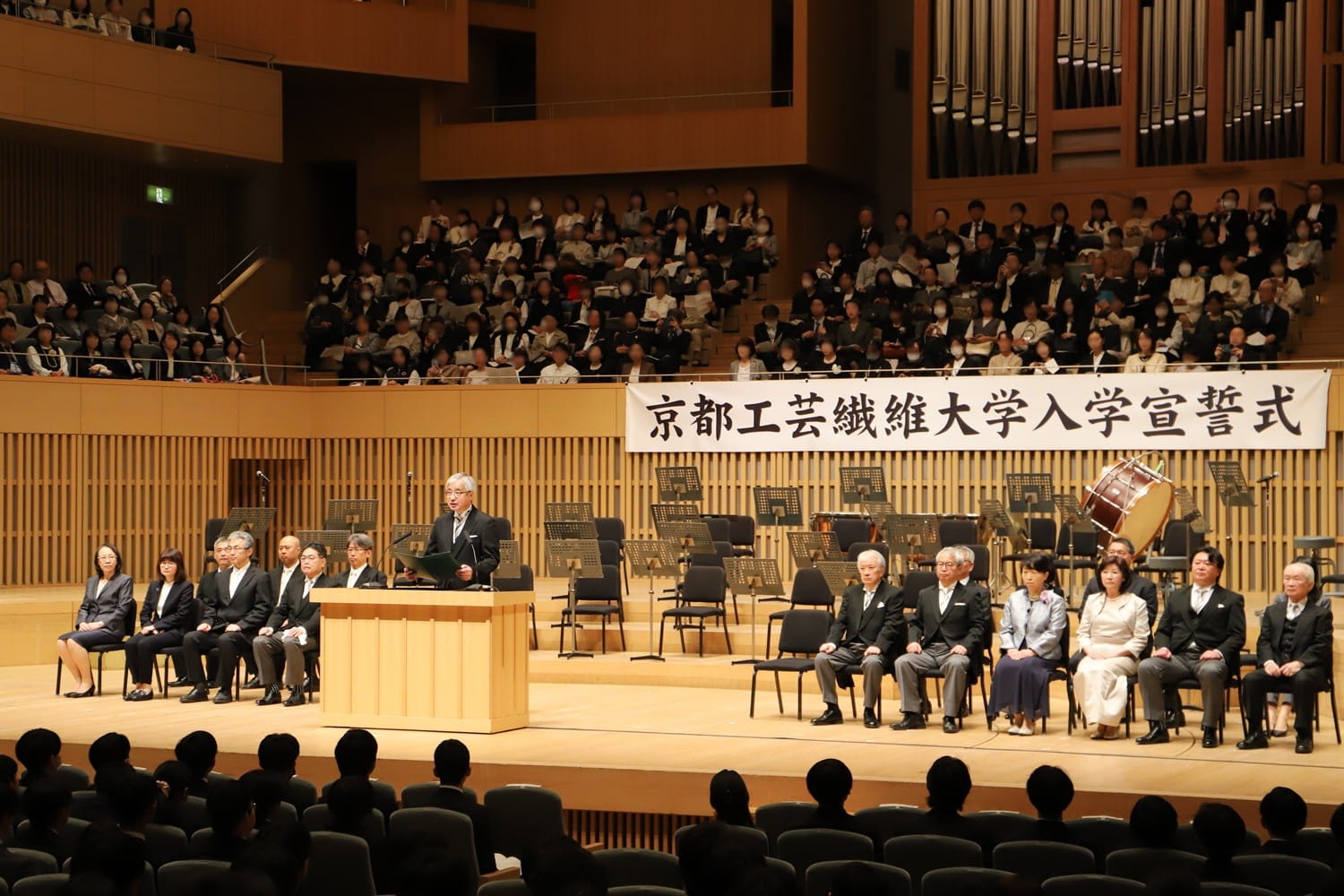
The KIT community is committed to nurturing internationally minded, advanced engineering professionals who possess comprehensive knowledge, a strong ethical grounding, and the vision and drive to lead. In other words, we seek to produce individuals who can contribute meaningfully to the advancement of industry, society, and culture. We refer to the graduates we aim to create as Tech Leaders. In addition to developing a strong sense of self, we expect our Tech Leaders to develop three core competencies: specialized expertise, proficiency in foreign languages, and leadership.
Let me begin with an illustration of what we mean by specialized expertise. This quality forms the very foundation of what it means to be a Tech Leader. As undergraduate students, you will now begin steadily constructing this foundation within your chosen field.
Along the way, you will encounter theories and concepts that feel far removed from everyday intuition. There will be moments when you struggle, and you may find yourself wondering whether you are truly suited for your field. Here is an example from my personal experience. In my discipline of electronic engineering, quantum mechanics plays a central role. This theory is rather counterintuitive to our sense of the world. As a student, I found it genuinely difficult to grasp. Through hands-on research experience, however, I encountered phenomena that quantum mechanics explains. This deepened my understanding of the theory.
Developing specialized expertise is much like building physical endurance through training. It is the steady accumulation of quiet, persistent effort that eventually becomes real strength. This is true even of the greatest minds. Hideki Yukawa, the first Japanese physicist to receive the Nobel Prize, is said to have struggled as a student with what were then cutting-edge concepts of quantum mechanics, and to have worried that physics might not be the right field for him after all.
Having worked through that difficulty, in his book, The Creative Person, Yukawa wrote that creativity grows from a proactive, hopeful orientation toward what we do not yet fully understand. What he found was important was a self-driven effort to make sense of things, rather than a passive waiting to be taught. It is by finding the essential questions for oneself, and continuing to think them through, that new knowledge and new value are born. This outlook has important lessons for innovation and is the essence of creating something genuinely new in the world.
Today, the rapid rise of generative AI is posing new questions about the role of specialized expertise. Artificial intelligence can draw inferences from vast amounts of data — but it is human beings who evaluate and select those results, and who give them meaning and value within society. It is also human beings who retain the capacity for judgment when circumstances are unpredictable, or when underlying assumptions dramatically shift. This is precisely why the ability to pose your own questions and continue thinking for yourself will matter more than ever in the years ahead.
Let me now turn to the core competency of leadership. Engineering exists for people, is refined through human relationships and finds its purpose within society. For a Tech Leader, leadership is the essential capacity to bring your abilities to bear in the world.
The management thinker, Peter Drucker, observed that leadership is not a rare, innate quality, but a skill that anyone can learn and develop. Whether you are outgoing or reflective, talkative or quiet, you can become a leader. University life offers many opportunities to nurture that quality; through extracurricular activities, practical training, and laboratory work. I ask that you learn to see failure as a growth opportunity, and step forward to take on challenges.
The third vital competency is foreign language proficiency and above all, English. English is an indispensable tool for engaging and collaborating with people from different countries and cultural backgrounds. Our English Intensive Program has been recognized as one of only four outstanding programs selected from among the national, public and private universities in Japan. I advise you to make full use of this valuable opportunity to improve your communication skills. We also offer overseas internships, summer schools, and many other opportunities for international exchange. Sharpen both your technical expertise and your English skills, and open your eyes to the world. Through the experience of learning, talking, and working alongside people from across the globe, I hope you will grow into Tech Leaders who create genuine value on the world stage.
Finally, I want to speak about the development of a strong individual identity. Learning is not, at its core, a solitary endeavor. It is through questioning, through learning how best to articulate questions, through discussion and subjecting ideas to scrutiny, that understanding deepens and horizons expand. The liberal arts and general education courses you take outside your major will be a great help in developing these skills. Engaging with classmates, students from different years, and faculty, encountering diverse perspectives and values, and, in doing so, shaping your own thinking and character, you develop the kind of genuine personal growth that a Tech Leader needs.
Venture beyond the boundaries of your own discipline. Engage with people from other academic perspectives. Take on as many cross-disciplinary encounters as you can. These experiences will broaden your perspective and become the very force that enables you to forge your own future path.
In the years ahead, you will learn a great deal, meet many people, and face many challenges. Each of these experiences will shape who you are and in time, become the source of your ability to create new value in the world.
Through your studies here at KIT, I encourage you to grow into someone who asks your own questions, thinks for yourself, and forges your own path. It is my sincere hope that one day I will see you flourishing in the world as a Tech Leader who brings something truly new into the world, in whatever area of specialization you choose to pursue.
Congratulations and a warm welcome to all of you new students.
April 6, 2026
Masahiro Yoshimoto, President
Kyoto Institute of Technology