
A Message from the President on the occasion of the 2025 Academic Year Degree Conferral Ceremony of the Kyoto Institute of Technology
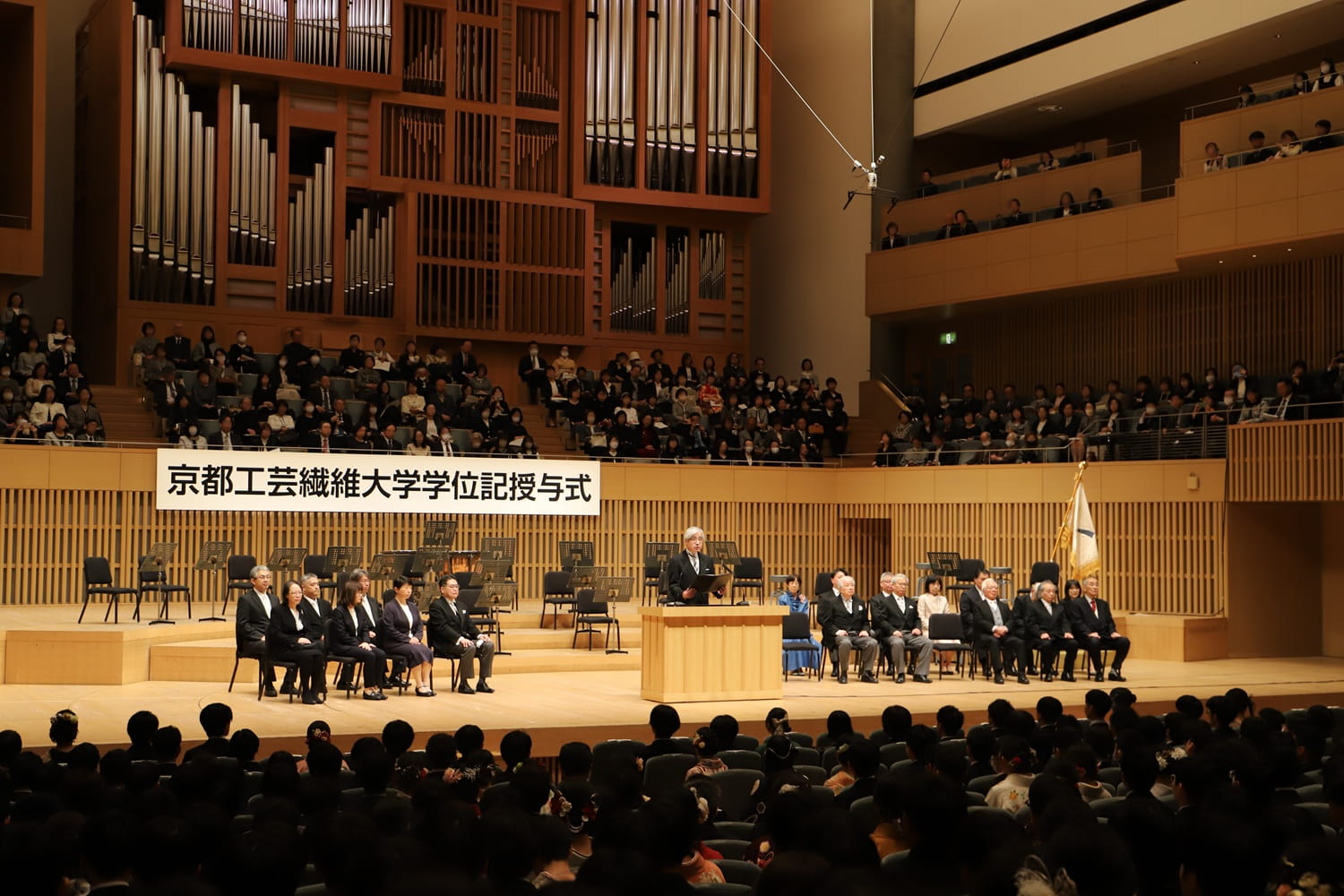
Congratulations to all of you receiving a bachelor’s, master’s, or doctoral degree today. On behalf of Kyoto Institute of Technology, I would like to extend my heartfelt congratulations to you. I also wish to express my gratitude to your families, everyone who has supported you, and the faculty who have guided you.
Today, 608 students receive bachelor’s degrees, 483 receive master’s degrees, and 23 receive doctoral degrees. Our university aims to cultivate internationally minded, advanced engineering professionals — people with broad knowledge, strong ethics, and the ability to contribute to industry, society, and culture through vision, execution, and leadership. As you are aware, we refer to such professionals as Tech Leaders, and we expect them to possess three core abilities in addition to a well-established sense of self: foreign language proficiency, specialized expertise, and leadership.
First, I will speak about the need to establish a strong sense of self — your generation experienced an unprecedented crisis in the form of a global pandemic. Those of you completing master’s programs began your university lives right in the midst of this unfortunate period. For you who were finishing undergraduate or doctoral programs you were each, no doubt, deeply affected in ways unique to your circumstances.
Six years ago, at the start of the pandemic, we were forced to cancel our March 2020 graduation ceremony and April entrance ceremony. All first semester classes moved online. The first-year students at that time — those of you receiving master’s degrees today — could not even set foot on campus until August when face-to-face classes resumed. I vividly remember the classroom scene when students in my third-year course reunited after five months apart, genuinely overjoyed to see one another again.
Learning is not, by nature, something best achieved alone. Understanding deepens and perspectives broaden when we question, discuss, and challenge one another’s ideas. Through interaction with peers, seniors, juniors, and faculty, we encounter diverse values and gradually shape our own thinking and character. This process of the “establishment of self” is a vital pillar of a Tech Leader. You have overcome a crisis that threatened that very process.
As you go on to create new value in society as Tech Leaders, the insights you have gained through diverse human connections will remain indispensable. The measure of engineering is its impact on people’s lives and it is sharpened and given meaning through engagement with others. I encourage you to step outside your academic field, connect with people from different disciplines, and boldly take on new challenges outside your comfort zone.
I would now like to say a few words on specialized expertise and language ability. These two Tech Leader capabilities are now being profoundly shaped by the rapid evolution of artificial intelligence, a trend that will only accelerate. You are the first generation to have used AI tools throughout your student lives.
About ten years ago in machine translation, a shift from older statistical methods to neural-network-based translation occurred, improved dramatically and began making internet-based translation a daily convenience. The language barriers that once hindered the exchange of specialized knowledge, cross-cultural dialogue, collaboration, and mutual trust have been steadily receding. Yet language is more than a barrier to overcome — it is a bridge to genuine understanding. For this very reason, I hope you will continue improving the foreign language skills you developed here and go on to thrive on the global stage.
Since around 2023, large-language-model-based generative AI has begun influencing the domain of specialized expertise as well. For example, it was reported that this year’s National Common Test for University Admissions saw generative AI achieve perfect scores in nine subjects and a 97% score rate across fifteen subjects. Because AI began as an attempt to replicate the workings of the human brain, it is tempting to think it can simply replace humans. Let’s remember, however that in the same way that the airplane, developed by mimicking the flight of birds, became something fundamentally different from a bird, artificial intelligence and humans differ.
AI can only reason after learning from vast amounts of data, and it is humans who select and judge the outputs AI generates. Humans also retain the ability to make decisions in entirely unpredictable situations or when foundational assumptions suddenly collapse. Going forward, it will be more important than ever to make appropriate use of AI while continuously refining and deepening your own expertise. I look forward to seeing you leverage your specializations and take bold steps toward a society where humans and AI coexist.
Let’s look now at leadership, the third Tech Leader skill you were trained to exercise. In his book, The Effective Executive, management thinker Peter Drucker describes leadership as fundamentally a matter of work and action. He defined leadership as the work of setting goals, determining priorities, establishing standards, and maintaining them and he identified its three components as work, responsibility, and trust. He argued that leadership can be learned by anyone: introverts and extroverts alike, the talkative and the reserved. Through your research lab activities and extracurricular pursuits, I trust you have already experienced the essence of leadership first hand.
Looking ahead, you are about to face a society in rapid transformation. FUKUZAWA Yukichi, who lived through the Meiji Restoration, reflected on his own life in his 1875 work, An Outline of a Theory of Civilization, in which he wrote that he had “lived two lives in a single lifetime,” meaning that in the course of one life, he had inhabited two entirely different eras. In a world where AI is advancing at speed and change is relentless, many of you will likely experience this two-lives-in-one phenomenon. Your experience of the pandemic, and the qualities you have developed here as Tech Leaders, will be a source of strength as you step forward into new challenges in this turbulent world.
Finally, I want to speak about joy and delight, the driving forces behind all great endeavors. Some of you have known the joy of pursuing truth, the thrill of discovery that is the engine of scholarship. Some of you have known the joy of making things, the satisfaction that drives engineering forward. And through collaboration and connection with others, through mutual recognition and empathy, there is the joy of flourishing together. Joy and delight are linked to dreams and hope. These emotions, and this capacity for empathy, are the source of a Tech Leader’s strength, and I believe they will become ever more vital in a society where humans and AI coexist. I have no doubt that you will achieve great success and contribute to the peaceful, prosperous society that our university holds as its founding ideal.
Congratulations to you all. I wish you every success in the journey ahead.
March 23, 2026
YOSHIMOTO Masahiro
President
Kyoto Institute of Technology