
President’s Address at the AY2026 Graduate Program Fall Entrance Ceremony
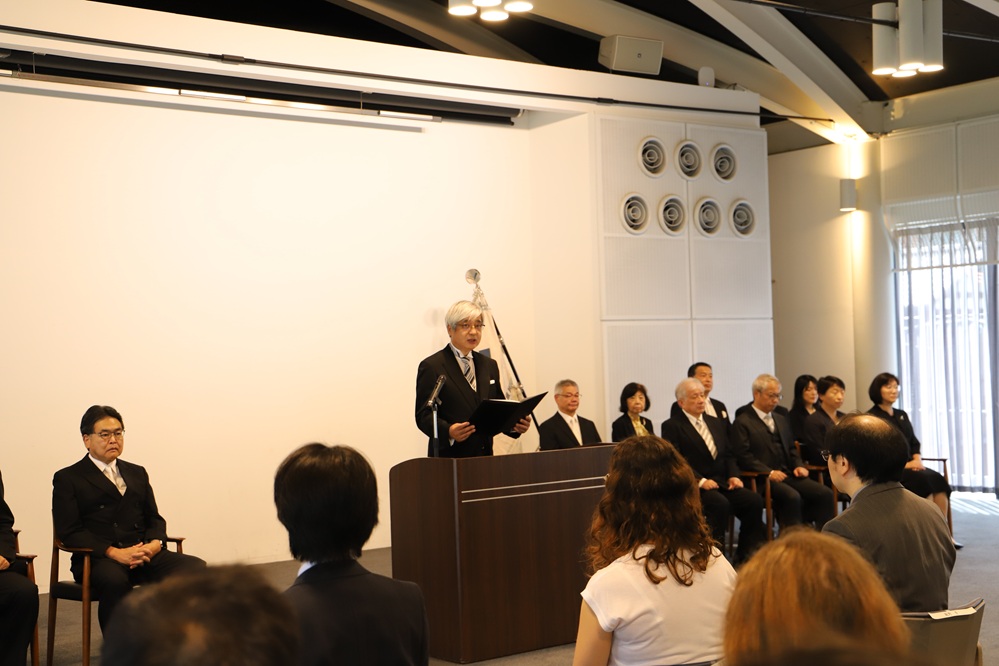
Congratulations to all of you who are entering or advancing to the Graduate School of Kyoto Institute of Technology. Today, we mark this important occasion by welcoming 39 students to our Master’s Program and 23 students to our Doctoral Program. On behalf of the faculty and staff of Kyoto Institute of Technology, I extend my heartfelt congratulations to your families and all those who have supported you along the way.
As president, I sincerely hope that your time with us will be a fulfilling and rewarding one.
Up until now, in your undergraduate studies, you have primarily studied knowledge that has already been systematized. You will find that graduate school is different. Here, while deepening the specialized knowledge you acquired as undergraduates, you will begin in earnest to learn how best to formulate your questions and work with your peers to find answers. In the Master’s Program, you will engage in a full series of processes—from planning and design through evaluation—in solving concrete problems. In the Doctoral Program, you will develop the ability to identify problems for yourselves, solve them, and create new value.
At the heart of this kind of graduate-level learning is what we call hypothesis formation.
Allow me to give you a familiar example of this concept. The Honda Super Cub motorcycle has, since its release in 1958, become the best-selling motor vehicle in history. Because it became widely popular not only in Japan but also throughout Southeast Asia, some of you international students here today may even have ridden one. Hypothesis formation played an extremely important role in the development of the Super Cub as I will explain.
Simply improving on existing motorcycles could never have produced a global success on this scale. Soichiro Honda, who developed the Super Cub, had thought deeply about the question: “What kind of vehicle would enable more people to get around more easily?” Working from the premise that it had to be small and lightweight, he holistically considered ease of handling, fuel efficiency, durability, and manufacturability, among other factors. And from among the many possibilities for realizing such a vehicle, he came up with an entirely new kind of motorcycle: the Super Cub.
It is important to note that Soichiro Honda established the desired outcome: “a vehicle that would enable more people to travel more easily” before moving into the design phase. He then conceived something that did not yet exist in the world, a product that would connect this desired outcome with the underlying principles and laws of nature, economics, and other relevant fields. The act of conceiving of something that does not yet exist is what I mean by hypothesis formation. It is at the very heart of engineering.
In your undergraduate studies, deductive and inductive reasoning were central to how you thought. Deduction derives specific conclusions from established principles and laws; while induction derives general laws from individual facts. But deduction and induction alone could never have produced the concept of this new type of motorcycle.
Graduate study is, at its core, about actually working through the process of realization — choosing among many possible paths — and internalizing the process of hypothesis formation along the way. Here’s an example from architecture. Hiroyuki Yoshikawa, an expert in precision engineering and general design theory who served as President of the University of Tokyo, stated that “architecture is the quintessential example of hypothesis formation.” Suppose we start with the premise of creating an architectural structure, and set as our objective a required function—for example, “a residence in which 100 people can live comfortably.” From an infinite number of possibilities, we conceive a single specific way of realizing that architecture. Again, this is hypothesis formation.
So far, we’ve seen hypothesis formation in the context of designing things that solve concrete problems — a motorcycle, a building. You might think hypothesis formation is only for people building things, but it’s just as essential when the goal is pure understanding, not application. How does it function when our goal is to deepen our understanding of new knowledge, theories, and phenomena? Yoshikawa points out that when Newton discovered his three laws of motion, there were two instances of hypothesis formation. The first occurred when he narrowed down the subject of his research. The second occurred when he established the laws themselves. Narrowing down the subject of research is itself an important act of hypothesis formation.
Newton had an extensive knowledge of light, so extensive that he even invented his own telescope. He was also an alchemist. Yet when considering the laws of motion, Newton excluded light and chemical reactions from the scope of his investigation. With the benefit of hindsight, we know that this was an excellent decision. But the decision to exclude those subjects did not occur through deduction or induction alone.
Newton’s second act of hypothesis formation was establishing the three laws—the law of inertia, the equation of motion, and the law of action and reaction—as fundamental laws capable of explaining the motion of objects on Earth and celestial bodies. In this way, across all the fields of specialization represented at our university, the most important aspect of graduate education is to develop the ability to formulate, for yourself, hypotheses about “what we should aim for” when there is no predetermined right answer, and follow that with “how we should achieve it.” As I mentioned above, this is what makes graduate education fundamentally different from undergraduate education, where you have primarily developed the ability to derive correct answers from questions that have already been given to you.
Hypothesis formation is an essential form of reasoning at KIT. It is fundamental not only to the engineering we pursue to create value, one of the principles embraced by our university, but also to the expansion and creation of knowledge and to scientific discovery. I sincerely hope that, during your time in graduate school, you will formulate your own questions, discuss ideas and collaborate with your peers, learn from perspectives across different academic disciplines and cultures, and take on the challenge of creating new value.
Many students joining us for graduate studies this autumn are working professionals and international students. Graduate education becomes richer with the diversity of Japanese students, international students, working professionals, and corporate researchers interacting across disciplinary and professional boundaries and inspiring one another. Some of our international students may find it challenging to begin a new life in an unfamiliar cultural environment. Our university, however, is in a peaceful setting away from the hustle and bustle of central Kyoto. We have cultivated an academic culture characterized by both tranquility and independence, while proximity provides our students with easy access to Kyoto’s rich cultural heritage. I hope you will take advantage of and enjoy this. I encourage you to feel at ease, and actively engage with your fellow students and faculty members, devote yourselves to your studies, and share your culture and perspective with those around you.
To conclude, I sincerely hope that your activities and experiences at the School of Science and Technology at Kyoto Institute of Technology will be fruitful and rewarding. Welcome new graduate students. Once again, please accept my heartfelt congratulations.
September 25, 2026
Masahiro Yoshimoto
President, Kyoto Institute of Technology