
President’s Address at the AY2026 Graduate Program Fall Commencement Ceremony
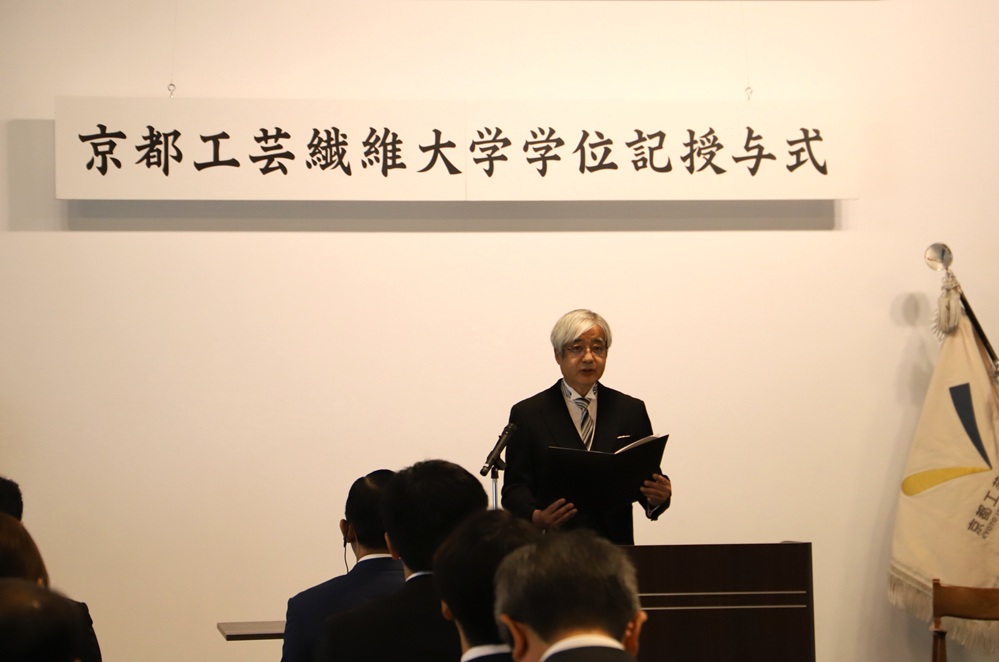
To all of you who are receiving your master’s or doctoral degrees today, my heartfelt congratulations. On behalf of Kyoto Institute of Technology, I extend my warmest wishes to each of you. I would also like to extend my sincere congratulations and gratitude to your families and all those who have supported you throughout your journey, as well as to the faculty members who have guided your research.
Today, we are conferring degrees on 45 master’s graduates and 16 doctoral graduates, including one recipient who has earned the degree through the “Thesis Doctorate” process. With the addition of today’s graduates, we will have awarded a total of 14,125 master’s degrees and 1,451 doctoral degrees, since the establishment of the Graduate School of Science and Technology in 1988.
As you embark on this new chapter of your lives, I would like to offer you one word: empathy. By empathy, I do not mean simply acknowledging another person’s opinions. Rather, empathy is about making the effort to understand why a person has come to think the way they do, even when you yourself cannot agree with their opinion. Empathy can also be described as the intellectual capacity to understand people who are different from ourselves.
Kyoto Institute of Technology jointly operates an international collaborative education program — a ‘joint degree’ program — with Chiang Mai University in Thailand. It’s through that connection to the region that I’d like to share a story with you: about 200 kilometers north of Chiang Mai, lies a mountainous area called Doi Tung. Until around 40 years ago, many people in this region depended on opium cultivation for their livelihoods. A foundation established by the Thai royal family launched a 30-year initiative in 1987. The Doi Tung Development Project aimed to eliminate drug cultivation and help ethnic minorities become self-reliant by establishing stable, legal, and dignified means of earning a living. This initiative has been recognized by the UN Office on Drugs and Crime as one of the world’s best models of alternative development, and has been highly praised both in Thailand and internationally. Today, the people of Doi Tung have completed their transition from narcotics cultivation and are engaged in industries such as coffee and macadamia-nut farming, tourism, and handicrafts that draw on local traditional culture including pottery and handmade paper. Have you heard of Doi Tung coffee? It’s now available here in Japan.
Central to directing the strategy in this regional revitalization was a person known as Khun Chai. How difficult it must have been to help people whose environment, livelihoods, and spirits had been devastated by drug cultivation rebuild their lives and achieve self-reliance. Rather than criticizing their behavior, Khun Chai empathized with the circumstances that had produced that behavior. Instead of dictating plans from above, he valued information from the ground, talked with residents, and moved the project forward through trial and error. This process is vividly described by the renowned management scholar Ikujiro Nonaka in his book Survival-Driven Management (Yasei no Keiei). Khun Chai placed great importance on firsthand experience in the field, accurate primary information, and learning from failure. In other words, for him, empathy meant re-examining the world from the other person’s standpoint, and discovering new possibilities from within that world.
This kind of empathy is also indispensable in everyday engineering. In fact, a lack of empathy can sometimes lead to catastrophic accidents such as occurred forty years ago when the Challenger, a U.S. Space Shuttle, exploded. Many of you may have seen, in archival clips or documentaries, the shuttle emitting a huge plume of white smoke shortly after launch, before breaking apart in the sky. Subsequent investigation revealed that the accident was caused by the O-rings, a synthetic rubber component used in the solid rocket boosters. These O-rings lost their elasticity due to low launch-time temperatures, resulting in a failure.
At the time of this tragedy, I was a doctoral student, and although on a much smaller scale, I was using the same type of component in an apparatus I was building. Naturally, I was doubly shocked to realize that a phenomenon occurring in something so familiar to me had been the cause of such a catastrophic accident.
In the case of the Challenger disaster, some engineers had expressed concerns about the component in question even before the launch. Within the organization, however, these technical concerns were ultimately overshadowed by past successes, established practices, the launch schedule, and management considerations. Under pressure to conform, the organization arrived at a final decision that led to the tragedy. Perhaps those who wanted to keep the launch on schedule were unable to give due consideration to the legitimate claims of the few engineers who raised objections, and the reasoning behind them.
In the future, I believe that you too will face moments where it becomes critically important to overcome organizational pressure to conform and to understand why someone holds an opinion you cannot agree with.
It is only through this kind of empathy that we can truly understand logic and backgrounds different from our own. This level of empathetic understanding allows us to relativize our own thinking, in other words, to step back and reconsider our own assumptions and in turn, to identify key issues. And it is precisely this discovery of key issues that gives rise to new wisdom.
In Survival-Driven Management, Nonaka writes that to see the way forward, we must engage in life-or-death deliberation with people who hold different subjective views, aspirations, and opinions from our own. We must transcend our own egos and reach a selfless state, without either deference or compromise.
This is increasingly relevant to life in the AI-coexistent society we are now entering — one in which AI is no longer merely a tool for human beings, but is integrated into society as a partner with whom we collaborate and alongside which we live. In such a world, empathy toward people who hold different perspectives, aspirations, and opinions is increasingly important.
Building on the qualities you have cultivated here at Kyoto Institute of Technology as TECH LEADERS, I am confident that, by continuing to exercise the muscle of “empathy with difference” you will go on to make meaningful contributions in many different fields and assist with building peaceful and prosperous social systems in keeping with the ideals of this university.
Once again, my heartfelt congratulations to all of you. With my best wishes for your continued success and accomplishments in the years ahead, I conclude this congratulatory address.
September 25, 2026
Masahiro Yoshimoto
President, Kyoto Institute of Technology